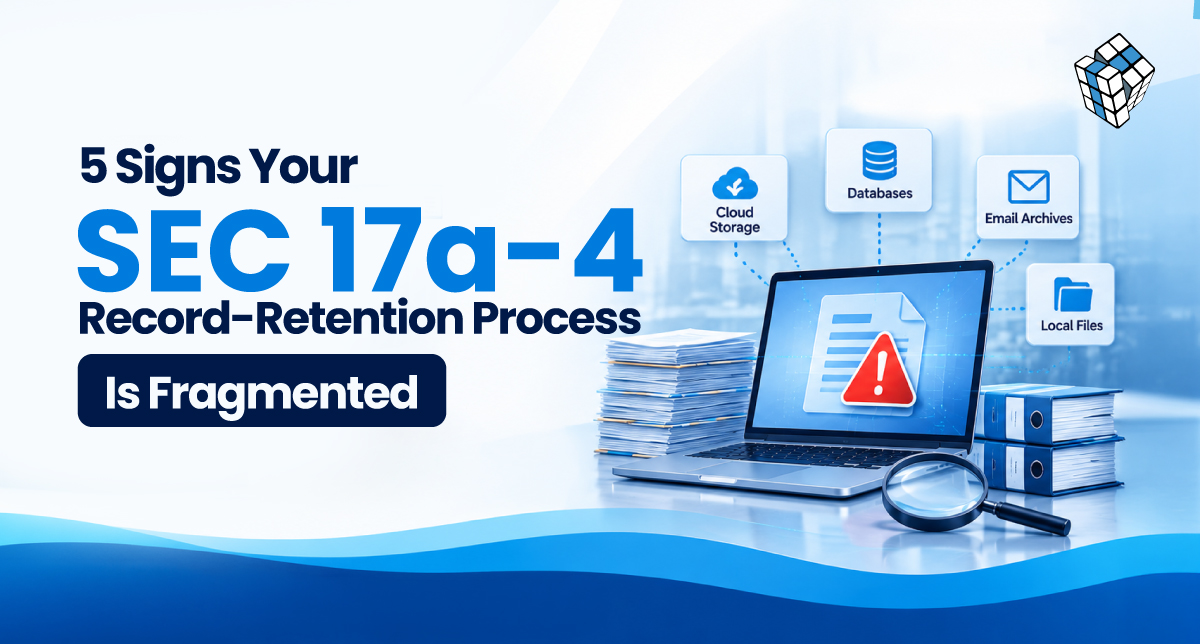
A regulatory examination is just two weeks away, and your compliance team is preparing to retrieve records from multiple systems. Trade-related communications sit in one archive, call notes in another, and approvals are scattered across shared drives. Then comes another challenge: confirming which retention periods apply and whether every required record has been preserved.
Sound familiar?
This is how fragmented SEC 17a-4 record retention can complicate everyday compliance operations for broker-dealers. While individual teams may have their own processes under control, bringing everything together for a regulatory examination can reveal gaps in visibility, consistency, and record retrieval. Recognising these warning signs early can help firms address potential issues before they become larger compliance concerns.
How to Identify Fragmented SEC 17a-4 Record Retention
Fragmented recordkeeping means required records are held across disconnected systems, managed through separate processes, and visible in full to no one. So, how can broker-dealers identify it? Look for five signs we’ve listed below. If two or more sound familiar, the process deserves a closer review.
Sign 1: Your Records Are Scattered Across Multiple Systems
Transactions live in one archive, and reporting sit on a shared drive. Each platform has its own administrator, its own retention settings and its own way of naming things. That is how a firm ends up applying different rules to SEC 17a-4 records that belong together.
Here is where things get complicated. When a retention policy changes, someone must update every system separately, and one is almost always missed. Teams also lose a complete view of what the firm actually holds. Start by listing every repository that holds required records and compare its settings with your written policy. The broker-dealer recordkeeping requirements apply to the records themselves, not to whichever system happens to hold them.
Sign 2: You Cannot Easily Track a Record's Complete Lifecycle
Pick any record and ask: when was it captured, who has accessed it, is it under a hold, and when can it be disposed of? If answering takes a round of emails, lifecycle tracking is not where it should be. The usual causes are unclear ownership and manual tracking. One team assumes IT owns the archive, IT assumes compliance owns the policy, and a spreadsheet fills the gap. That makes it hard to show examiners that controls were applied consistently over time.
Review who owns each record category, and whether capture, access, hold and disposition events can be seen in one place.
Sign 3: Legal Holds and Special Retention Requirements Are Managed Manually
A hold notice goes out by email. Someone adds a row to a spreadsheet. Months later, the compliance teammate who tracked it has moved on and nobody is sure whether the hold is still active. Think about what happens when one system honours the hold while another continues routine deletion. The firm is left with confusion over which records must stay preserved, and that confusion is hard to explain after the fact. Clear retention policies and central oversight reduce the risk.
Ask whether holds and special retention requirements can be applied, tracked and released through one controlled process rather than scattered reminders.
Sign 4: Retrieving Records for an Audit Takes Too Much Time
Imagine an auditor request arrives with a tight deadline. Your team searches several repositories, exports the results, then checks whether the set is complete. Hours turn into days.
Slow retrieval is rarely just a search problem. It often points to weak record organization and limited compliance visibility. SEC 17a-4 record retention requirements are only part of the picture, because firms also need to produce the right records promptly and show that nothing is missing.
Precision retrieval, meaning the ability to find exactly what was requested without pulling everything nearby, is a strong indicator of audit readiness. Test it with a mock request and time the result.
Sign 5: Your Compliance Team Lacks Centralised Visibility and Access Control
Effective recordkeeping requires more than preserving records. Compliance teams also need visibility into retention exceptions, outstanding compliance tasks, user permissions, and record access activities.
When broker-dealers manage records across multiple systems, maintaining consistent oversight becomes difficult. Access permissions may vary between platforms, former employees may retain unnecessary access, and compliance officers may struggle to identify exceptions that need attention. Without centralised monitoring, these gaps can go unnoticed until an internal review or regulatory examination.
While a unified compliance dashboard is not an explicit SEC 17a-4 record retention requirement, it can help firms strengthen recordkeeping oversight. Centralised visibility and role-based access controls allow compliance teams to monitor activities, review permissions, and identify potential issues before they become larger compliance concerns.
Go From Fragmented to Centralised Recordkeeping
Fragmented recordkeeping rarely announces itself. It tends to surface when someone has to retrieve, verify or account for a critical record, and by then the gaps are harder to explain. Why manage critical compliance records across disconnected systems when you can bring greater visibility, control, and efficiency to your recordkeeping process?
RSMS Vault by Capital Market Solutions helps broker-dealers move beyond fragmented workflows with a centralised solution designed to simplify record management and strengthen compliance oversight.
With a unified compliance dashboard, gain a clearer view of recordkeeping activities, while role-based access controls help ensure appropriate user permissions. WORM-style storage supports record integrity, and transparent record lifecycle tracking provides visibility throughout the retention process.
From legal holds and special retention management to precision retrieval for regulatory examinations, RSMS Vault equips compliance teams with the tools to manage SEC 17a-4 compliance records more efficiently and confidently.
Stop managing records in silos. Start managing compliance with greater clarity and control.
Explore RSMS Vault and take the next step towards centralised, audit-ready recordkeeping.
What is SEC Rule 606 reporting?
SEC Rule 606 reporting requires broker-dealers to disclose information about the routing of customer orders according to applicable reporting requirements. A reliable SEC Rule 606 reporting solution helps organize and validate relevant data for accurate, consistent reporting.
Can CAT data be used for SEC Rule 606 reporting?
CAT data contains order lifecycle and routing information that may support SEC Rule 606 reporting. However, CAT and Rule 606 have different regulatory requirements, so the relevant data must be classified, transformed, and validated before it can be used for Rule 606 reports.
How does an SEC Rule 606 reporting platform help compliance teams?
An SEC Rule 606 reporting platform such as RSMS helps streamline data processing, validation, and reporting workflows. It also supports cross-regulatory CAT and Rule 606 surveillance, helping compliance teams identify inconsistencies and improve visibility into reporting processes.
